Watch conditions by zone
Follow fine particles, carbon dioxide, volatile organic compounds, temperature, and humidity across the spaces you manage.
Understand changing conditions across your building. VaperViper brings air-quality readings and possible vape events into a clear, zone-based view for schools and public facilities.
Air-quality sensing · Zone-based alerts · Facility visibility
Illustrative values only. These are not live measurements or health classifications.
A sensor reading is a starting point. Looking at trends, occupancy, and location helps facilities teams decide what to investigate and where to focus.
Follow fine particles, carbon dioxide, volatile organic compounds, temperature, and humidity across the spaces you manage.
Combine particle and gas changes over time to flag possible vape plumes. Show the relevant zone on a floor map so staff know where to look.
Send zone-based alerts to facilities, security, or administration. Use the location and trend to guide a follow-up rather than relying on one number.
Switch between sample scenarios to see how different readings might prompt different questions. The goal is to help staff choose what to investigate.
These scenarios are illustrative. They do not classify a room as safe or unsafe, diagnose a problem, or describe a real facility.
Illustrative values only. These are not live measurements or health classifications.
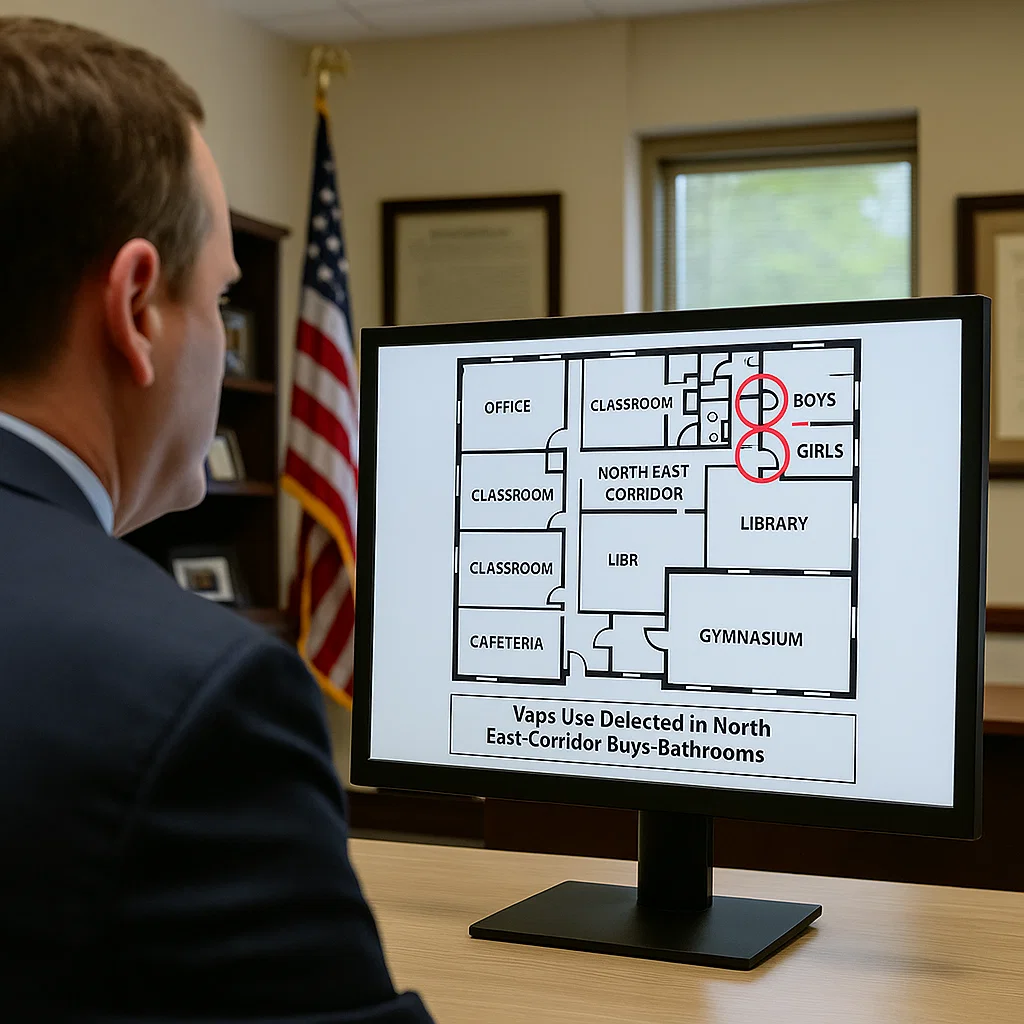
Zone-based event mapping helps staff locate an alert. Review the reading pattern and check the space before drawing a conclusion about the cause.
Use a pilot to test sensor placement, background conditions, and the response workflow with your facilities team.
Plain-language background from public-health and building-standards sources.
EPA links school environmental conditions with health and academic performance. Air monitoring can help teams investigate conditions as part of a broader maintenance program.
Read the EPA overview ↗CDC explains that e-cigarette aerosol can include nicotine, metals, fine particles, and volatile organic compounds. It is more than water vapor.
Read the CDC explanation ↗ASHRAE ventilation standards address building design and operation. A sensor reading alone cannot establish the ventilation rate or certify compliance.
Explore ASHRAE guidance ↗For additional context: CDC/NIOSH ventilation guidance ↗. Sources checked October 9, 2026.
Choose the rooms and zones that matter to your facilities team.
Review typical conditions during occupied and unoccupied periods.
Agree on alert settings, recipients, and how events will be checked.
Compare trends and event history to improve placement and response.
Particles describe material suspended in the air. CO₂ can help provide context about ventilation and occupancy. VOCs are gases from a range of sources. Temperature and humidity add environmental context. No single reading describes every aspect of indoor air quality.
Treat a possible vape event as a signal for staff to review. Other particle or gas sources can affect readings. Pilot testing should establish site-specific behavior and the appropriate response.
Readings can support investigation and maintenance decisions. They do not independently certify health, ventilation performance, or compliance. Use the applicable guidance and qualified facilities review for those assessments.
Tell us about your facility, areas of concern, and timeline. We'll discuss a pilot that fits your building and your team's workflow.